Food UGC Strategy
UGC for food brands: video formats that actually move product on shelves and online
Pantry Social Studio · July 2, 2026 · 11 min read
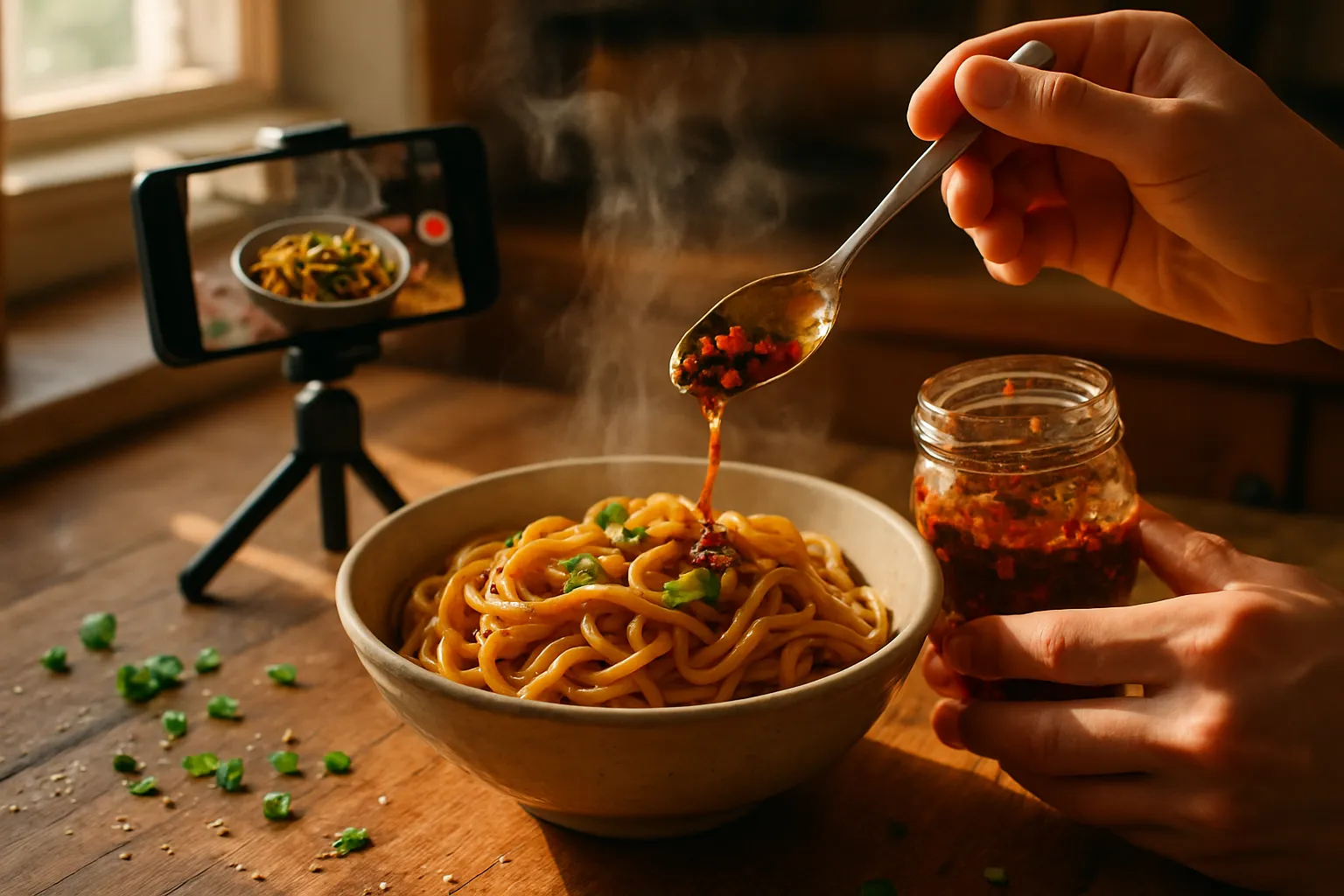
Food UGC works when you treat it as a library of purpose-built video formats, each mapped to a channel and a specific job in the retail funnel, not as a pile of one-off clips.
Most food brands still brief UGC the same way: send product to a creator, ask for a thirty second video of them using it, run whatever comes back. Then they wonder why the account has forty clips and none of them are pulling. The problem is not the creators. The problem is that "a person holding a product and saying they love it" is not a format. It is a shrug. It shows enthusiasm without showing the thing a shopper actually needs to see before they add to cart, walk to the shelf, or repeat the purchase. Food is sensory, situational, and habit driven. The buying decision hinges on taste, texture, and where the product fits in someone's day. A generic testimonial answers none of that. This post lays out the video formats that do. Think of it as a library, not a mood board. Each format shows a specific thing, does a specific growth job, runs best on specific channels, and sits at a specific point in the retail funnel. Build the set, rotate through it, and you stop guessing.
Why food UGC is a system, not a genre
A single video can only carry so much. A taste test proves the product is good. A restock video proves it belongs in someone's kitchen. A comparison video gives a hesitant shopper permission to switch. These are different jobs, and no one clip does all three well. When you treat UGC as one undifferentiated genre, you get overlap where you needed range: five videos that all say "this is delicious" and zero that answer "how do I actually use this" or "why should I pick this over the brand I already buy." A system fixes that by starting from the jobs. Map the retail funnel first: awareness (they learn you exist), consideration (they weigh you against alternatives), trial (they buy once), repeat (they buy again and tell people). Then assign formats to the gaps. Most food brands are overweight on awareness content and starved for trial and repeat content, which is exactly why paid performance plateaus and retail velocity stays flat. The rest of this post walks the core formats one at a time. For each, the same four questions: what it shows, the growth job it does, where it runs, and where it sits in the funnel.
Recipe integration
The workhorse. A creator builds a real dish and your product does a real job inside it: the finishing oil, the sauce that ties it together, the protein, the swap that makes a weeknight dinner feel like something. This is the format that turns a jar on a shelf into a habit, because it answers the quietest and most important objection in food: I don't know what I'd do with it.
- What it shows: the product in genuine use, the sensory payoff (the pour, the pull, the sizzle), and a repeatable occasion the viewer can picture themselves in.
- Growth job: product education and usage context. It converts curiosity into a reason to buy by making the product useful, not just appealing.
- Where it runs: Reels, TikTok, and Shorts organically, strong as paid social on Meta and TikTok, and excellent on DTC product pages and email where it lifts conversion.
- Funnel: consideration and trial. It moves someone who is interested into someone who has a plan for the product.
Taste test and first reaction
The honest bite. A creator tastes the product on camera and reacts in real time: the eyebrow lift, the pause, the "wait, that's actually good." Reaction is the closest thing video has to letting a shopper taste through the screen. Done without a script, it carries sensory proof that no adjective on your packaging can match. See more on this in sensory proof in food UGC.
- What it shows: unfiltered flavor and texture response, the crunch or the creaminess, and the specific descriptors a shopper is scanning for.
- Growth job: trust and appetite appeal. It de-risks the flavor gamble that stops first purchases.
- Where it runs: TikTok and Reels first, TikTok Shop for direct conversion, and as top-of-funnel paid social hooks on Meta.
- Funnel: awareness and trial. A strong reaction is a scroll-stopper and a trust signal at once.
Pantry and fridge restock
The belonging format. A creator restocks their pantry, fridge, or freezer and your product goes back in its spot alongside the staples they already trust. This is quiet, powerful social proof: your product is not a novelty, it is a repeat buy that lives in a real kitchen next to the eggs and the hot sauce.
- What it shows: the product as an established staple, its packaging in a real home context, and the implied repeat purchase.
- Growth job: normalization and repeat signaling. It tells prospects this is something people keep buying, and reminds existing buyers to restock.
- Where it runs: TikTok and Reels organically, retargeting on Meta, and as retention content in email and SMS flows.
- Funnel: consideration and repeat. It builds the sense that the product is a fixture, not a trial.
Grocery haul
The discovery format. Your product appears inside a real shopping trip, on the counter with everything else the creator bought, mentioned as a find. Hauls are how a lot of food discovery actually happens now, and they place your brand in the context that matters most: someone chose it, at a store, on purpose, next to everything else they buy.
- What it shows: the product as a deliberate pick among many, retail context, and often the store or channel where it was found.
- Growth job: awareness and retail cue. It puts the product on the radar and tells people where to get it.
- Where it runs: TikTok and Reels for reach, Meta for prospecting, and it doubles as retail velocity content brands can share with buyers. More on that in retail velocity content.
- Funnel: awareness, with a nudge toward trial when the where-to-buy is explicit.
Product demo
The mechanism format. A tight, close-up look at how the product performs: the pour viscosity, the melt, the shake, the mess-free spout, the way the crumble holds. Demos answer functional questions that reaction videos skip. For a lot of CPG products, a small functional detail is the whole reason someone switches or hesitates, and demo is the only format that shows it clearly.
- What it shows: product performance and format details, texture and consistency in macro, and any functional differentiator.
- Growth job: product education and objection handling. It resolves the practical doubts that stall a purchase.
- Where it runs: Amazon and DTC product pages, TikTok Shop, and as mid-funnel paid social on Meta and TikTok.
- Funnel: consideration and trial. It converts interest into confidence.
Shelf-edge and shopper POV
The in-aisle format. Shot from the shopper's point of view: finding the product on the shelf, reading the front of pack, picking it up, dropping it in the cart. This format closes the gap between online discovery and the physical purchase, and it is gold for brands fighting for velocity in retail, because it rehearses the exact moment a buyer needs to happen in the aisle.
- What it shows: the product in its retail environment, how to spot it on shelf, and the physical act of choosing it.
- Growth job: retail conversion and findability. It trains shoppers to locate and grab the product in store.
- Where it runs: Reels and TikTok for reach, Meta geo-targeted around retail footprints, and as sell-in and velocity proof for retail partners.
- Funnel: trial, specifically the in-store purchase. It is the bridge from feed to shelf.
Founder and product story
The reason-to-believe format. The founder or a creator tells the short version of why the product exists: the gap it fills, the ingredient standard, the thing the category got wrong. In a crowded set, story is the differentiator that a demo cannot carry. It gives people a reason to root for you, not just a reason to buy.
- What it shows: origin and standards, the specific problem the product solves, and the human behind it.
- Growth job: brand affinity and differentiation. It builds preference that survives a price comparison.
- Where it runs: DTC site and About content, longer TikTok and Reels, and as a paid social hook for brand-led prospecting.
- Funnel: awareness and consideration, with a long tail into loyalty.
Comparison and "I replaced X"
The switching format. A creator directly frames the product against the thing the viewer currently buys: I swapped my usual for this, here is what changed. This is the most direct permission-to-switch format there is. It meets the shopper at the exact fork in the decision and hands them a reason to move. Handle claims responsibly and keep the comparison honest, but do not skip this one. It punches above its weight.
- What it shows: a side-by-side against a familiar alternative, the specific reason to switch (taste, ingredients, price per use, cleaner label), and the outcome.
- Growth job: conversion and category capture. It converts users of competing products.
- Where it runs: strong paid social on Meta and TikTok, TikTok Shop, and Amazon where comparison intent is highest.
- Funnel: consideration and trial. It is a decision-stage closer.
How to choose: a decision model, not a vibe
You do not run every format at once. You choose based on where the brand is stuck. Start with the funnel diagnosis, then pick the format that fixes the specific leak. If reach is fine but nobody converts, you have a consideration or trial problem, so lead with demo, comparison, and recipe integration. If people buy once and never again, you have a repeat problem, so lean into restock and story to build the habit and the affinity. If no one knows you exist, you are awareness-starved, so front-load taste test, haul, and reaction. If online is healthy but retail velocity lags, you need shelf-edge and shopper POV to move the purchase into the aisle. Then match format to channel by intent: high-intent shopping surfaces like TikTok Shop, Amazon, and Instacart reward demo and comparison, while discovery surfaces like TikTok and Reels reward reaction, haul, and recipe. If you want this as a guided flow, the food UGC format chooser walks the same logic step by step.
From clips to a library: make it repeatable
One-off videos age out. The Meta account fatigues, the TikTok hook stops landing, and you are back to briefing from scratch every month. A library solves this by treating formats as templates you refill, not clips you commission once. Pick your core formats, define the shots each one needs, and run a creator rotation so the same format arrives in fresh faces, kitchens, and voices every cycle. That is how you get evergreen that still feels new: the recipe integration format stays constant while the dish, the creator, and the hook change. Angle variety matters as much as face variety, so pull multiple angles from a single product, as in one product, ten angles. Then run it like a testing menu, not a lottery. Ship variants, read the winners, retire the losers, and refill the fatigued slots before performance drops, which is the whole point of a CPG creative testing menu. When a format tires, the fix is a new angle or a new creator in the same format, not a blank page. That is the difference between a content pile and a UGC video library.
What good looks like across the set
The tell of a working food UGC system is coverage. Open the library and you should see every funnel job represented: awareness formats bringing new people in, consideration formats answering the real objections, trial formats getting the first purchase, and repeat formats building the habit. You should see the same format in several creators, several kitchens, several hooks, so nothing single-threads on one clip. And you should see the assets doing double duty: the same recipe integration cut running as a paid social hook, a product page video, and an email module. Public market examples make the pattern visible. Brands like Graza, Fishwife, Poppi, Olipop, and Magic Spoon did not win on one viral clip. They won on recognizable, repeatable format systems that show taste, usage, and belonging over and over. That is not luck. That is a library. If your videos keep saying the same thing to the same people, the answer is rarely more videos. It is the right formats, mapped to the jobs you are actually missing, as covered in creative fatigue in food ads.
Build the library, not a pile of clips
Pantry Social Studio builds creator-led video systems for food, beverage, grocery, wellness, kitchen, and CPG brands. We start from your growth jobs, map the format library to the funnel, and produce paid-social-ready assets in a creator rotation so your UGC stays fresh instead of fatiguing. Recipe, taste test, restock, haul, demo, shopper POV, story, comparison: each one built to do a job, not just fill a feed. If you want a clear read on which formats you are missing and where your funnel is leaking, book a food UGC systems audit and we will map it with you.
Frequently asked questions
What is UGC for food brands, really?
It is creator-led video that shows a food product in real use: tasting it, cooking with it, restocking it, comparing it. The point is not a person holding a product and praising it. It is a system of video formats, each built to show taste, texture, usage, or belonging, and each mapped to a specific job in the retail funnel.
Which food UGC format should I start with?
Start from where your funnel is stuck. If people do not convert, lead with product demo, comparison, and recipe integration. If they buy once and never return, use restock and founder story. If no one knows you exist, front-load taste test, grocery haul, and first reaction. Diagnose the leak first, then pick the format that fixes it.
How many video formats do I actually need?
Enough to cover every funnel job: awareness, consideration, trial, and repeat. For most food brands that means four to six core formats running at once, each refreshed through a creator rotation. It is better to run a handful of formats deliberately than to commission twenty one-off clips that all do the same thing.
Where do food UGC videos perform best?
Match format to channel by intent. Discovery surfaces like TikTok, Reels, and Shorts reward taste test, haul, and recipe. High-intent shopping surfaces like TikTok Shop, Amazon, and Instacart reward demo and comparison. The strongest assets get reused across paid social, DTC product pages, and email so one shoot does several jobs.
How do I keep food ad creative from fatiguing?
Treat formats as templates you refill, not clips you commission once. Keep the format constant and rotate the creator, the dish, the kitchen, and the hook. When a variant tires, swap in a new angle or a new face within the same format instead of starting from a blank page. That is how you get evergreen that still feels new.
Written by the Pantry Social Studio team — a food-first UGC and creator studio working with grocery, snack, beverage, pantry, kitchen, and CPG brands. We brief and produce creator content for organic and paid social.
Related Pantry Notes
Creative Formats
Food UGC Examples: Formats Grocery and CPG Brands Can Actually Use
A practical tour of food UGC examples — taste tests, recipe integrations, grocery hauls, pantry restocks, demos, and paid hooks — and what each one actually sells.
7 min readFor brands
Creative Formats
Taste test, haul, restock: which food UGC format should you use?
How to choose between creator reactions, grocery hauls, pantry restocks, product demos, and comparison videos.
6 min readFor brands
Food UGC Strategy
Sensory proof: the missing layer in food UGC and CPG ads
Appetite appeal is not decoration. It is the proof mechanism that earns the first three seconds, holds watch time, and builds belief before purchase.
9 min readFor brands
Brands: source food-first UGC
Tell us what you need and we'll help identify creator fits by category, format, style, platform, and usage.